One of the pleasures of my slower off-farm professional pace is that I have time to focus on some of what people imagine farmers do all the time, and many don’t do at all, or like me, do it as a ‘guilty pleasure’ that takes away from the activities that actuall keep the farm going.
One of these distractions from actual farming, that I’ve been doing a lot of lately, is food preserving. I’ve never committed to a goal in terms of how much of our own food we produce or harvest (wild) here on the farm but I’d like to think it’s >25% and sometimes I can convince myself it might someday be 50%.
In a northern temperate climate like Wisconsin that means two things. Animal protein, and food preservation. The animal protein comes as a fairly natural biproduct of our own sheep dairy activities (Milk needs lactation, which means pregnancy and therefore lamb), my own modest hunting activities and relationships with friends who also farm in small idiosyncratic ways like our friends at DreamFarm (https://www.facebook.com/p/Dreamfarm-100064519516935/) , the best goat cheesemaker in Wisconsin, in the driftless who we source our pork from (heritage, humane, whey fed). But for veg I rely entirely on what my chaotic garden activities can produce for me.
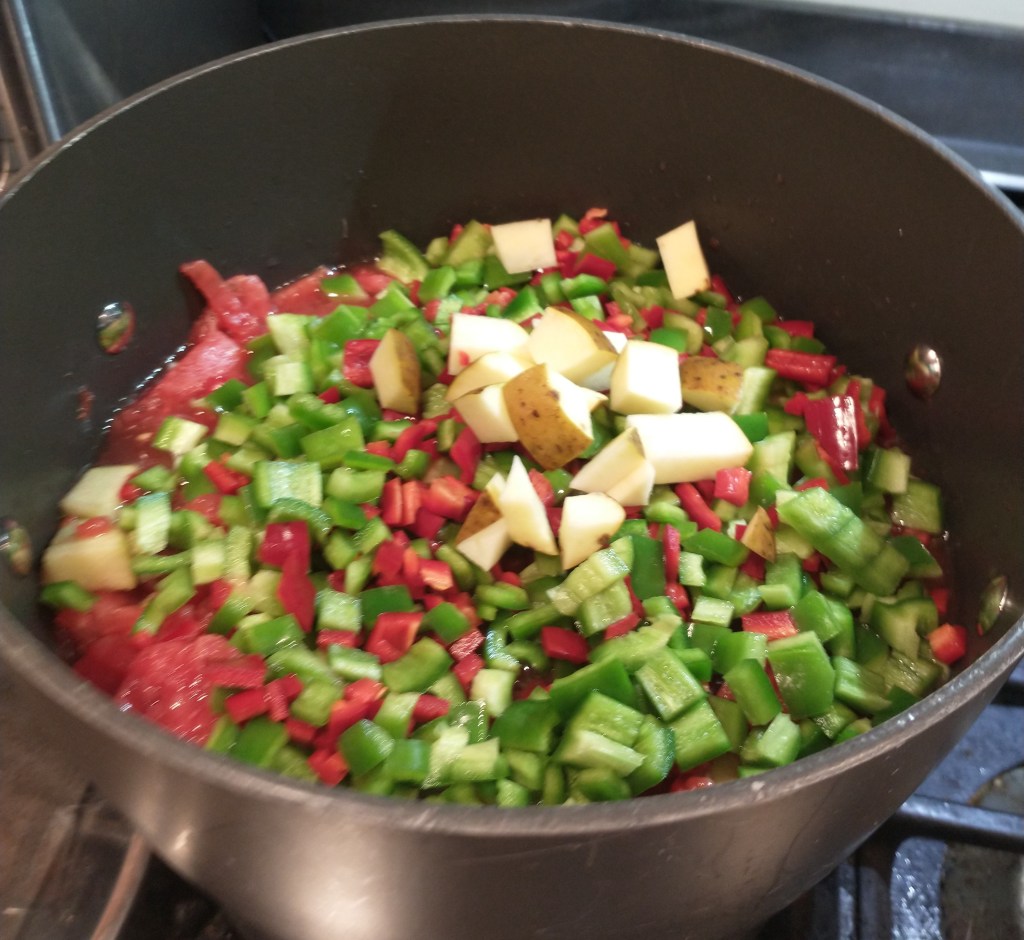
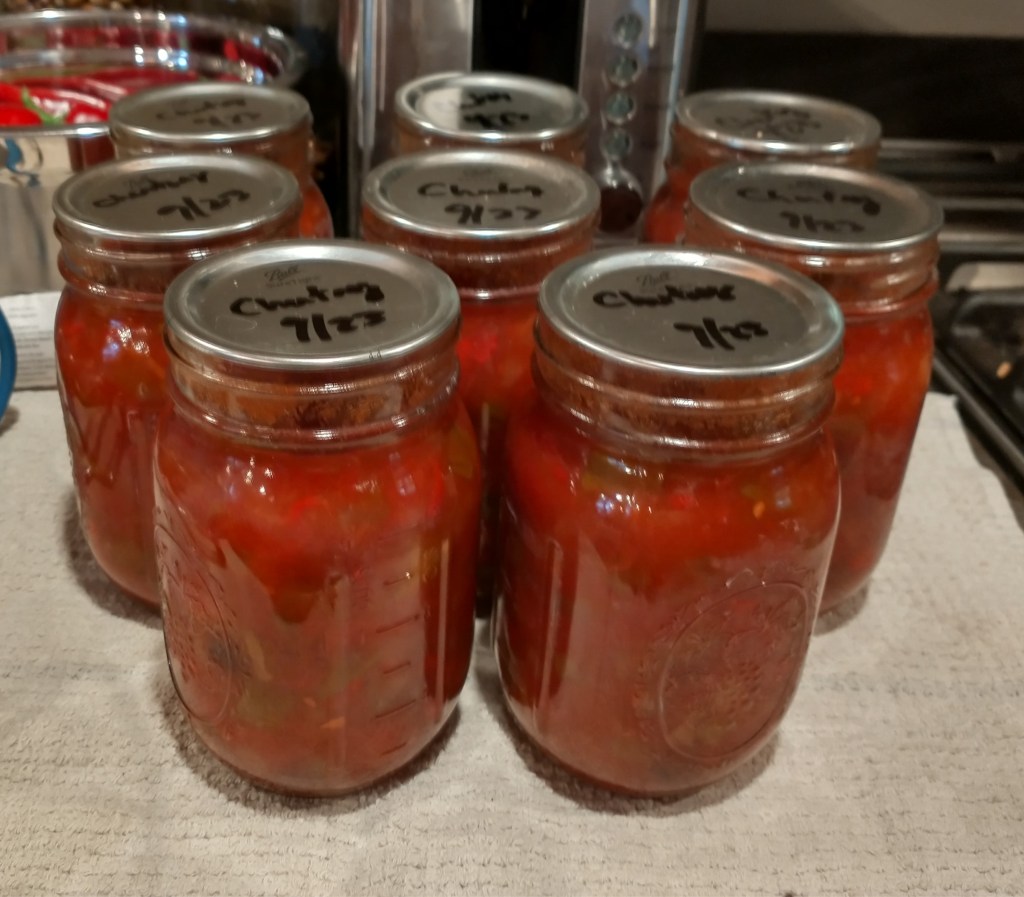
So I’m canning Chutney in late September thinking about how, despite my aspirations, I can’t make this ‘apple tomato chutney’ recipe from the Ball book, because I don’t have cucumbers in September …
… which makes me wonder WHO and WHERE do you have apples ripe and cucumbers ripe at the same time… thankfully our integrated global vegetable supply chain provided me with some nice 50 cent cucumbers from Latin America at our local Wal Mart grocery so the chutney proceeded… But I think it highlights the challenges of really feeding yourself locally, which the restauranters and homemakers who aspire to this are well aware of.
You’ll certainly not starve in the Wisconsin winter… it’s a kind landscape, it’s a kind land, that seems to ‘want us to live’, unlike some of the climates I’ve lived in. We have abundant game, and a few odds and ends in the forest to stave off scurvy, and a good solid 5 months of vegetable permissive weather to delight in… probably 3 of which are really a cornucopia…
But a local winter diet is going to get pretty starchy, quite meat driven, and of course rely on preserves…which is why I’m canning. Global supply chains have let us eat a lot healthier than that, even if most of us don’t, and so the local food thing just has to be seen as an inspiration, or an asymptote or something we can aspire to but if we want to eat well is going to challenge us, and … my provocative assertion of the blog … if we want to be vegan, might well kill us.
I think veganism must have arisen in the places like India, where I participate in it myself, and enjoy it the most While India has wet and dry seasons, they pretty much always have temperature and light regimes that support lots of vibrant, fresh, lovely veggies. Meat eating, dairy in all it’s manifestations… these things, perhaps inevitably, predominate in climates with long winters, where the only fresh thing growing in January is an animal and if it’s not going to lactate right then and there, you need to eat it… but by the way, when it’s <0c, it keeps quite nicely hanging outdoors in a shed, provided you protect it from the other omnivores, and carnivores, who have similar designs on their diet. Be happy and embrace that we’re omnivores and can manage in all these climates…
But something like chutney, with it’s odd convergence of cucumbers, apples, ginger… that’s either a recent invention, or something invented in South Asia and renamed by the British…I don’t know which… But let’s be glad a bit, that we have global supply chains, that let us make chutney !
This blog got started in February and has been incubating around the edges of the daily sad news cycle, disease, racism, a crisis in leadership and in community in the US…that have just reinforced the starting thought. It then lay dormant for 6 months and a friend reached out and tactfully asked me, ‘have you died?’… in a much less shocking way… so that’s brought me back to the blog in Mid October a week from our national election… this might be a good time to try to push it out the door… you’ll see it’s badly out of phase with the current season, as I look out the window at our first dusting of October snow here in Wisconsin.
I think the essential appeal of the Agrarian Dream is the sense of control over the essentials that homesteading brings. Reading the little house books, or the foxfire books, or just about any homesteading literature… there’s a great deal of adversity and despair, but there always seems to be a pumpkin in the attic, some straw to twist and burn in the fireplace, or a pig that can be butchered. We’re enjoying that sense of security, as well as thinking about what we can do to share the abundance as it comes.
Our own small markets are disrupted as many have been. Amanda’s thrice weekly trips to Madison, that included egg deliveries to friends and colleagues, have ceased, her work either disappearing or moving on line depending on the client. The egg sign has gone back out at the end of the lane, so at least no one driving on our road will be short of eggs. Our cheesemaking market development is on pause for the season, as our target B2B markets of high end, local centered, restaurants are on life support. The lambs are getting to pick up the slack and we’re fortunate to be working with these flexible animals, who can manage on the milk line, or just raise their lambs, unlike our neighbors milking cows, some of whom are having to dump milk, while grocery stores and food pantries are short of supplies.
There’s no denying the sense of comfort and satisfaction it creates to know that even in “total lockdown” while we shelter in place, that there’s still a 1 mile walk around the perimeter of the land. There’s still a long to do list, and in the spring with the days getting longer and warmer there’s no threat of starvation and even little threat of monotony. The diversity of farm work keeps things varied and the spring weather of the upper Midwest going from 75 degree highs to 29 degree lows in 48 hours also make for excitement. Two months on in mid-July we’ve already had two long stints of August weather…had the AC running for two one week stints… it sure feels like global warming is real.
The garden is in full on jungle phase at this point, everything is growing exponentially, weeds included, though no working off the farm, and not travelling for my consulting business, things are in better order than they deserve to be. A first good cutting of hay is in the barn and a second cutting badly wants done but the weather isn’t cooperating.
Lambs have grown quickly with their Mom’s milk and a first load is going to Equity this week or next. Our prices (touch wood) have stayed pretty good at auction, but our access to butchering continues to challenge. We got the first opening on the schedule for JANUARY for five lambs. I have the sense that the disruption in the big plants that have had so many problems with Covid, has pushed demand down to any little place it could get absorbed, and that’s frustrating our efforts to build a meat business. We’re going to shell out the money, and pay the nuisance tax, to get licensed for on-farm frozen meat sales (one of the stack of licenses from Wi you need to sneeze on a farm here…)… so that we can get lambs processed when we can, and have meat on hand year round when people want to buy it. We’ll see if that turns out to be worth the effort, but without it we’re never going to be a stable enough supplier to build a market. In my basic approach to life of mitigating the downside scenarios we ‘weathered’ our male lambs this year, we took this decision in May, when the big food processors we’re in major train-wreck phase, and it seemed we could face a downside scenario of not being able to sell lambs off the farm. By weathering the males we can avoid having a bunch of 200 lb teengage rams trying to kill each other and us, forcing us to euthanise the way pig producers have had to (for other reasons). That looks unlikely now, but still gives me confidence that our 8 month old lambs we process in January will be tasty and without taint.
Then the summer got busy, as it always does, and the blog got neglected… so maybe a nice place to round out the year is revisiting-
“The Larder”
Fuel:
Firewood- About 4 cords put up in the shed, about 4 cords of milling scraps drying in piles. About a cord of elm, my go to “I’m behind” wood, ready to be split at the shed, and a fewmore cords on the ground.
Electric- solar array still humming away and still exceeding our use, though that should change this month.
Ag Diesel- After a spring top up we’re down to about 100 gallons. As it accounts for about 95% of our on farm hydrocarbon use, at some point I’ll do some first order maths and see how much of our diesel burn I can reasonably account for with carbon capture on woodlot.
Propane- is getting very light use now that I’m home most of the time…House tank 700 gallons, barn tank 300 gallons.
Food (mostly tracking the stuff we aspire to be self sufficient on):
Veg and future veg-
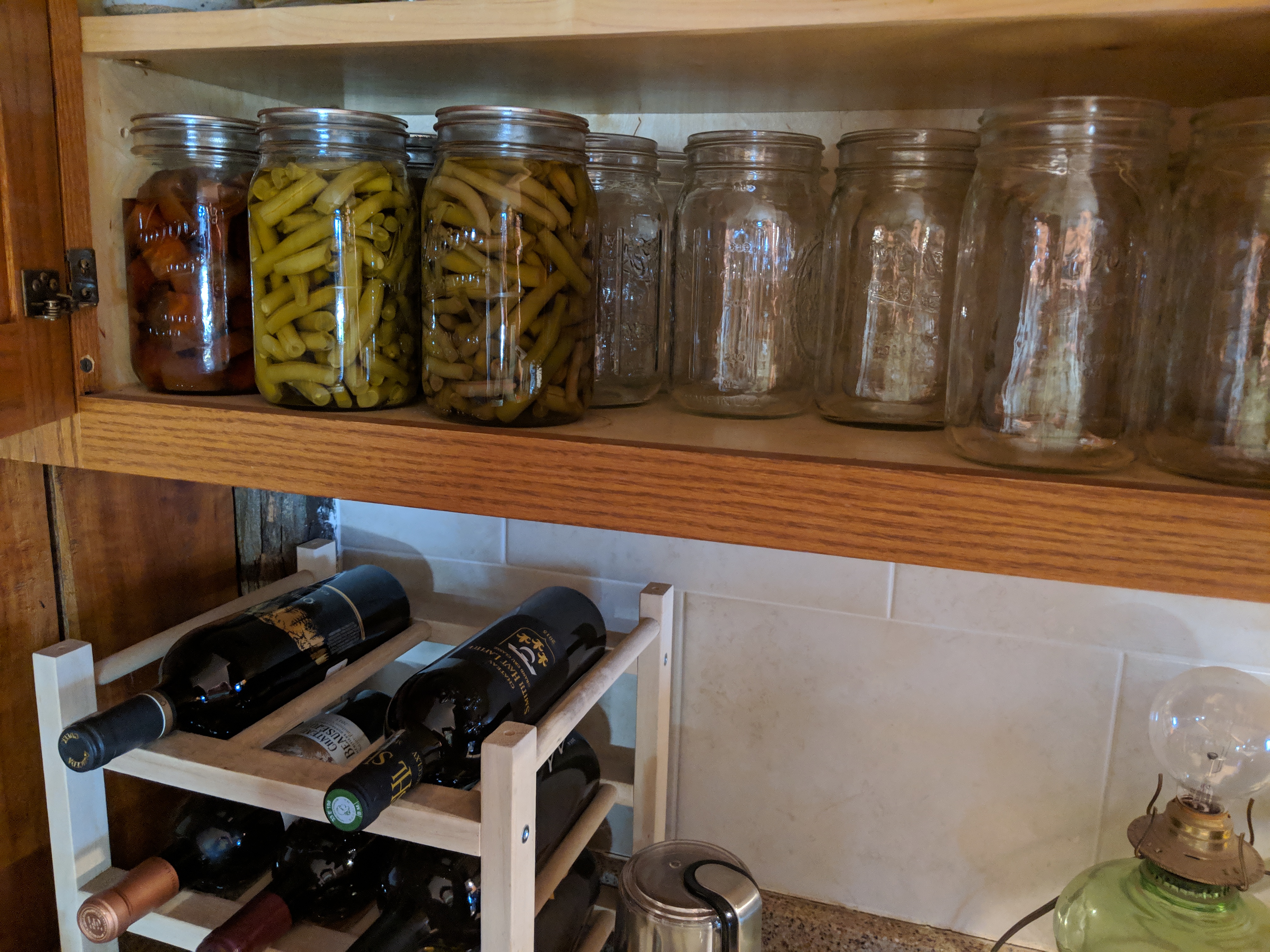
Green beans- canned: 3 case of 12 quarts
Beets- About 6 quarts canned
Salsa- About 6 quarts of red and 6 quarts of green
Peppers- about 10 pints chopped, bagged and frozen.
Potatos (i’m right there with you Dan Quale)- ~ 75 lbs, holding nicely a week after the dig
Dry Beans- about ½ a quart, dry beans got missed this year when things got busy…-
Lots of saved seed, very little commercial seed. I had a particularly bad year with commercial seed, poor germination… Gurney’s may be getting culled from my supply chain..
Two quarts of dried hops waiting for my seasonal brewing inspiration.
Some well established wild Asparagus and some poorly established new aspargus beds
Animal protein and sources-
In the freezer-
About ¼ of a delicious farm raised hog that Amanda bought from one of her cheesemaker mentors- a new one, but holding up well
The equivalent of 2 lambs, grown here on farm and butchered nearby, consisting of the cuts we don’t like the most (this is what happens when you eat the whole animal)
1 turkey
1 duck
Sources-
5 chickens of three laying breeds, After a varmit issue this spring, we re-stocked with 2 more Ameracunas… no one is laying now in mid October with our shortening days.
2 ducks who may at some point lay eggs
A vibrant flock of East Friesian/ Lacaunne composite dairy sheep doing well and ready to breed next month.
Abundant deer and turkey on the back forty.
Feed-
The grass is still holding a bit of green, but that may stop with todays snow.
About 75 round bales of Alfala- Grass- Straw from 4 nice cuts this year.
2 acres of corn standing in the snow waiting for me to get out there and start picking (by hand).
1 ton of oats raised on the farm and harvested with my 1953 Allis All Crop Combine (woot woot).
At the start of October things are looking pretty good in the larder !
It’s the end of the first solar year of my post-professional life, and a little over 6 months into the Land Ethic Journey depending on where you start the clock.
A good time for reflection and the farm scramble slows down for a few months this time of year.
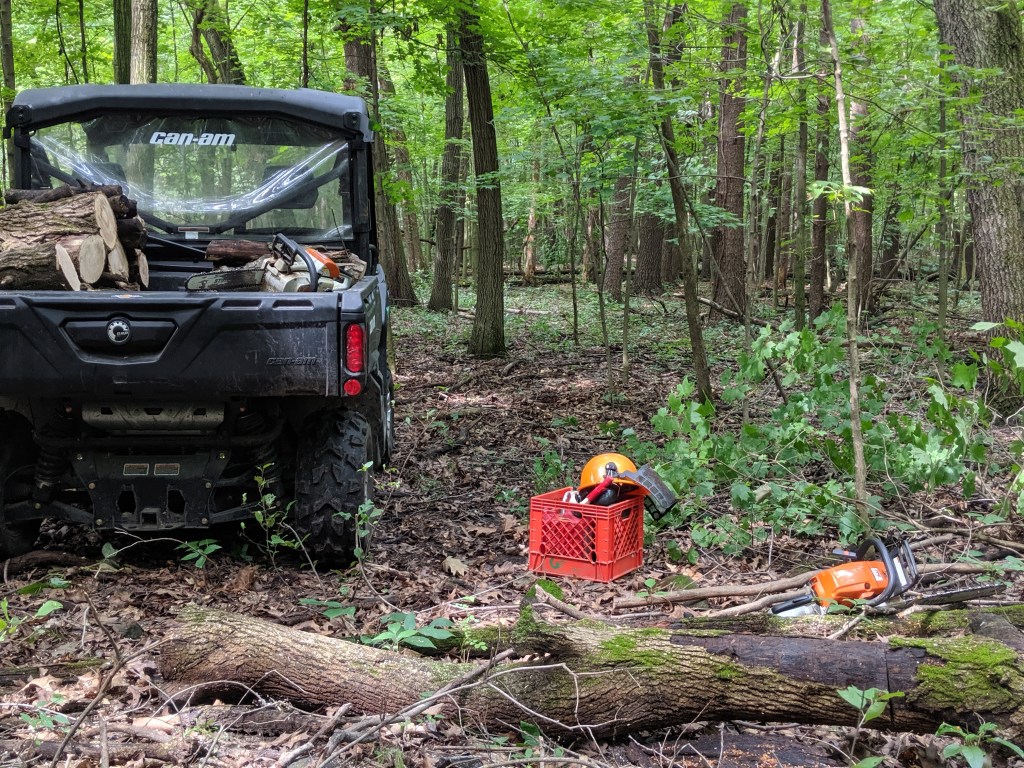
Temperatures have returned to more seasonable double digits in the 20s to low 40s since that freakish ultra low dive in October. We’re picking corn, by hand, from our ~ 2 acre ish plot, for feeding for the sheep and chickens this winter. I keep pondering a machine picker, or a combine, but the bottleneck and need just moves to another place. If I get a two row ear picker, then I need a grain wagon to put behind it to collect the ears, and an elevator to move the ears into my ~175 year old wooden corn crib. If I get a combine I need to add to that, a grain bin, with some drying capacity, to store the shelled grain in. So for the 4th year running I’m pulling ears and tossing them into the back of my UTV.
About 1.5 hours fills the UTV and the UTV fills about 8 saved 50 lb feed bags which get stacked in the corn crib. It all works pretty well until about January when the deer get really hungry and denude the field… I’m hoping that with not working I’ll be able to harvest the majority directly… we’ll see.
I’m squandering a few hours in the mornings and evenings, at sunrise and sundown, frightening our local deer with a variety of weapons. A crossbow purchase has increased my hunting flexibility greatly. I still chase them in the gun season as well and it’s nice having more time, but I’m still learning the land. I’m getting a good sense of location and flows of animals, and can pretty much see nice deer of some kind about 50% of my sits. I’m getting takable shots less often. It’s clear I need to invest the time and energy in some elevated blinds if I really want to consistently harvest. I hate the over-investment of money and time associated with that, but the nature of most of our ground is that I’m seeing deer at <50 yards most of the time, so if I’m not sitting in position for a shot (as in facing 90 degrees away), my movement to line up spooks them… having done some blind sitting with my buddy in Iowa over the weekend, and having a huge buck just stare at him oblivious after 4 dry fires (long story, but the lesson is, hunt with a gun you’ve shot in the last month…), because we were 20 feet in the air… well, it’s a big help to make clean kills, which I definitely aspire to do.
But, as observed by another good Iowa friend, the enforced mediation of just getting out in the woods before sunrise, or sunset, and sitting still and quiet for a couple-three hours… is its own reward, and a great meditation. Hopefully I will get something in the freezer this year as we have exhausted our lamb until February…
The wood pile is holding out well, despite the early onset of cold weather and deer hunting has been a great opportunity to contemplate the many 10’s of huge dead elm trees still available for heating purposes. They will be followed by Ash (see earlier posts on global trade driven extinction…) and it seems there is so much dead and dying ash in southern wisconsin I can’t even sell it for pulp. Very distressing as we have some 36” diameter ash in the back 40 …
It’s odd the books you run into and the times you run into them. Shortly after starting my Land Ethic Journey I stumbled onto the book ‘Prairie Fires: The American Dreams of Laura Ingalls Wilder’ An attempt at an actual biography of Laura, rather than the imagined but “true to life” stories the Little house books present. (https://www.amazon.com/Prairie-Fires-American-Dreams-Ingalls-ebook/dp/B0727NC3NN/ref=sr_1_1?keywords=prarie+fire&qid=1576617404&sr=8-1) For those of a certain age we were treated to the TV version of this as children and my own daughter was introduced to this charming dark childhood tale in book form. The ‘Little House’ books are ones of many that stimulate the Agrarian dreaming of middle class Americans and it was funny to run into this book on the beginning of my land ethic journey. It’s an actual biography, heavily researched and well cited. It’s interesting enough, despite that, to keep the pages turning, and a worth read. The author’s thesis seems to be agrarian dreams are bunk, and the Ingall’s were duped, and really Laura’s childhood was awful and traumatic and ultimately lead her own daughter to be somewhat mentally ill. Another way to process the same facts was that Pa should have just stayed in Wisconsin, and busted his but to earn some money and buy some land, rather than chasing the dream of a ‘homestead’ all over the American west, and certainly some of the logic of those times (“rain follows the plow”) was amazingly deciptive and fanciful thinking. The takeaway stands the test of time… one can have a good life on the land, if one has good off farm income, and that’s really what lead to the second, fairly happy, half of Laura’s life, supported by her true-ish but not grisly, tales of her childhood.
It forces one to wonder why a measurable subset of the human population is so attracted to the idea of putting down roots on a plot of ground that’s big enough to do for yourself, and make your own way. The appeal of ‘you won’t be rich but you won’t be hungry’ seems not quite universal, but certainly abundant in professional and wage workers of all types. Few do it, less succeed. The economics are not attractive and our first 6 months books bear that out…
Random reflections-
Things I’m satisfied with-
The garden harvest:
100 odd pounds of potatoes safely tucked underground in an improvised root cellar.
Copious bags of frozen peppers and onions for omelet making and other cooking tucked into the freezer
Canned ketchup and tomoatoes in abundance
The usual 3 cases of green beans on the shelf
Carrots in abundance and still keeping well in cold storage
Crops:
One acre of the best corn in Jefferson county… a rare year when being small helps a lot… planted on time, harvested dry, estimated at about 225 bu / acre
I want to say I’ve mastered making alfalfa hay… beautiful green leafy stuff, nice and dry… a story about right equipment and learning how to use (and not use) it, by observing the neighbors habits… very pleasing.
Livestock-
The chickens are returning to laying, and we’ve bought less than 2 dozen eggs from the store in 9 months, despite frequent omelets for breakfast and dinner
The sheep milked well after a few weeks of shenanigans, milking became almost pleasant and I really felt like I got in the groove.
The milk production levels lined up frighteningly well with my spreadsheet projections of 4 odd years ago. Which were based entirely on EBVs from the spooner genetics… suggesting that a milking herd of <30 sheep is going to suit our production goals really well.
Amanda made some wonderful cheese that made me really optimistic about producing a premium product that some of my favorite restaurants and shops will be excited to sell
Projects-
Getting stuff finished in general
Replacing my rusty old electric resistance water heater with a shiny new hybrid electric
Finally completing some finish carpentry in the house (window trim) that had stood undone for 4 years.
Things that didn’t go so well-
Livestock-
I loved raising my feeder pigs this year. They are great animals with a ton of personality, but because I didn’t book the butcher 6 months out I had to take them to equity, and I lost a solid 20 cents a pound…on nearly 1000 pounds of animal… even with free labor. A real bummer and a good, if expensive, lesson on not even thinking of trying to compete in commodity production.
The dairy-
More mastitis than I would have liked, probably because we still have more to learn than I wish… but thanks to our non-organic choice, a good large animal vet, and thoughtful use of antibiotics, we had no fatalities or culls due to mastitis this year. Progress but never good enough.
Projects undone-
I had this fantasy that with not working off the farm I’d finish tons of stuff on the to do list… it’s still distressing long, sawmill to finish assembling, cheese plant to project manage to completion, some plumbing improvements in the parlor are all waiting for a magical mixture of other transient things being completed, and the right weather time and motivation…
The garden-
A really weird weather year delayed harvest of anything edible well into the end of July.
Thoughts for the future and schemes-
A high tunnel greenhouse ????
Still fantasizing about 3 acres of oats, an allis all-crop combine, and being totally independent for feed, fodder and bedding for the sheep…
Finish that dam sawmill assembly, then drop some of those huge ash while they’re still good, and mill them for timbers
Typical picturesque view from the 75 mph moving train this past week… note the bailage marshmallows piled up next to the barn, and the pastures pushing up the mountainsides.
Time away from the farm is a blessing and a curse. I boarded my flight from Madison to Newark after the first light dusting of snow of the year, and overnight lows in the low 30’s and the promise of continued rain. But any period of more than a couple of days away from my agrarian dream comes with regrets. By the time I arrived in Zurich to visit my daughter, bleary eyed and re-connected to our shared deity, the internet, the weather expectations for Maggie’s farm had deteriorated exponentially. Persistent sub 30 temperatures in the 20’s made my focus on winterizing mechanical systems (milkhouse heat and animal waterers) look positively astute, but also made the things I’d neglected to get that done (digging 50 row feet of potatoes and 10 row feet of carrots) look like nightmarishly bad decisions. Had I not scheduled this indulgent week away I would have been outside madly plowing and shovelling all day on Halloween. My first love letter home to Amanda has the subject line: “ Save my taters.”
The blessings are enforced time for reflection, time for writing, reading, and even watching. I’ve about 2/3rd finished “The Driftless Reader” (https://www.amazon.com/Driftless-Reader-Curt-D-Meine/dp/0299314804), a collection of writings on the Driftless region of Wisconsin, that’s quite engaging and provides a great sense of place from many perspectives. Eight hours locked in an airplane included time to take in the film “Biggest Little Farm” (https://www.biggestlittlefarmmovie.com/), a fun ‘documentary’ film, that get’s air-quotes from me for documentary, because I think filmmaker and subject are a little too close to each other (being, it seems, the same) to create the sort of journalistic distance that my personal sense of documentary film requires. Nonetheless, it’s a fun film which I would recommend. The film will strike actual farmers as Disneyland-esque, and non farmers as a serious and challenging reality check to their imaginings of going back to the land.
Disneyland because these 250 acres <1 hour from LA are enabled by un-named “investors” who, after bankrolling the capital and operating expense of this operation for EIGHT YEARS, seem to be grossing what some twitter feed reading suggests is <250,000 USD per year. I’m sure they’ve got a business plan on file that will assuage the IRS. And hey, if the Donald can milk his losses-carried forward for a decade of tax free living, I’m on-board with these “investors” doing the same… But this modest income, in a fully irrigated, arguabley climatic Utopia for veg growing (compared to my 70 days above 60F in Wisconsin this year… you can bet their taters aren’t frozen this week), all with an army of woofers working seasonally for minimum wage (and admittedly delicious looking free food…) This is not a recipe for keeping the land in the family if that’s your goal. But, I give them an A for effort, and an A for intention, and an A for persistence verging on insanity, which may be the secret ingredient of all farmers.
Reality check, because for the non-farmers, the amount of waste and slaughter associated with figuring out (a bit unclear how fully figured out it really is at magical year 7) how to rear fruit, veg, and free range livestock from scratch, orgainically, is deeply depressing and trying. The scenes of Coyote (and wayward Livestock Guardian Dog) slaughtered laying hens, will be sadly familiar to those who have forgotten to shut the coop at night, and those who have not built the coop of grade-A materials. These are as real as real gets. The bushels upon bushels of bird and snail damaged fruit sure emphasize the utility of some farm pigs, who I’m sure enjoyed them greatly. The candid shots of the nearly emptly farmers market stands from the first few years look all too much like what I see from the starting farmers at the smaller farm markets in my part of Wisconsin.
The decision to leave the orphaned lamb to ‘figure it out’, is either heart wrenching, or anger making, depending on your perspective. If you’ve had a farming friend whose been chewed up by the animal rights machine, it sort of pisses you off to see how this is portrayed as a necessary step in the process to self fulfillment… [Conveniently, little Lambo survives by being a successful bummer. This is not an outcome you get with dairy sheep in March in Wisconsin, but maybe it does happen in California…]
If my professional farming neighbors and (previous) customers let animals die like this they’d be flayed by the media. If their employees let animals die like this, they’d be fired, but since these people have Right Intention, it’s just a painful lesson it making a go of Biodynamic farming.
All that said, it’s a good enough farming movie that I took away several ideas and insights…
Good ideas around barn owl houses… barn owls are beautiful and my barns are not decrepit enough for them to have roosted, but I would love to have some more of these predators on the landscape, keeping after gophers and federal squirrels who are the plague of both poorly mowed, or highly intercropped orchards. Winter to do list, plans for barn owl houses !!!
The scenes of poultry and lamb slaughter are so similar to my distant memories of farming in south central Pennsylvania, that I’m rethinking my rather casual attitude towards livestock protection. In 5 years on the Wisconsin farm our only predation has been by automobile, and I continue to be stunned by this, given the sound effects in the woods at night, by a population of coyotes with enough time on their hands to make stereophonic music most nights….
A reconsideration of whether we should get some ducks…
The temptation of keeping a sow, instead of just some feeder pigs, was raised by the lovely Emma, in the film. My conviction not to go organic was raised by watching Emma suffer through a near fatal case of mastitis, with apparently only treatment with an analgesic for fever reduction (the little details like whether Emma was seeing a real licensed vet, and what she was given, are glossed over, earning more ‘air quotes’ from me on the documentary side). Again, she seems to have lived, so… it’s all good right ???
But really, who doesn’t want 10 or so squirmy piglets every spring, instead of just two or three… to feed all that rotting veg to ???
Any farm movie that brings some good ideas is worth a watch.
Reflection also this week in my facilitated whirlwind mass transit based tour of Switzerland. Such a scenic country and so interesting to consider what kind of society makes the choices the Swiss do about place, technology or lack thereof.
It’s amazing to spend time in a place where it would arguably be insane to own an automobile. If we farmed here I think I could get by with a tractor, which I saw driving the streets of Zurich yesterday morning. I’ve travelled probably 750 miles in the country, almost entirely on electric driven mass transit, principally streetcars and trains, this travel itinerary augmented with a mountain hike about every other day of mountains in excess of 5000 feet. I keep wanting to say the wilderness access is amazing, but you can’t really call it wilderness if there’s a train to the top, and two hotels there. It’s cool nonetheless.
Some cows grazing next to the Funicular track…
Also delightful to see agriculture tucked in so closely next to these high places, on extreme slopes (45+%) without evidence of extreme negative impact. This is entirely because these grades are worked by the animals themselves, or by walk behind, 2 wheel tractors, like the one I garden with. Lots and lots of grass based production, and wrapped round bailage seems to be the preservation method of choice for livestock producers. Which makes me feel good about my big stack of hay.
Farmstead on the mountainside selling trailside farmstead cheese…
The few flat places in this country seem to be used in equal thirds for heavy industry, residential, and intensive Ag. Lots of greenhouses and hoop-houses right along what looks a lot like the GM plant in Janesville (but it probably makes a way cooler car, or a train more likely). Farm ideas and motivations from Switzerland include talking some more to my sheep friends using grass bailage, though I know my cheesemaker will object, and renewed energy to get the woods fenced and get some grazing and browsing going on in there. No livestock grazing the mountain hikes in the late fall here in Switzerland, but the pellets and pies say they were there a few weeks ago. Also, the great inspiration of a TRAILSIDE FARMSTEAD CHEESE “stand”… basically a refrigerator next to the trailside farmstead marked “AlpinKase” with a box for the money, much like we sell pumpkins… I wish I’d thought to take a picture from the funicular…
Reflection is good, but a week of forced reflection without physical labor, and without measurable productivity, in making or storing food, definitely make me want to get back to Maggie’s farm and hopefully get those potatoes dug…
Sometime between mid July and today, August 29th, Wisconsin hit its stride and became the place that Chief Blackhawk spoke of in Fort Madison, Iowa the year he died. “Rock River was a beautiful country. I liked my towns, my cornfields and the home of my people. I fought for it. It is now yours. Keep it as we did— it will produce you good crops.”
Typical August nightly fare….
The gift of abundance of this sandy loam soil on the edge of the Wisconsin glaciation comes forth in August, and surprises you, and challenges you to make constructive use of the abundance. A proper farmer would work themselves to exhaustion day after day preserving this abundance. A proper farmer would find ways to gift the abundance to those in need. No one in Wisconsin should be hungry in August, no child should lack for an understanding of the delight of garden fresh salads, tomatoes, cucumbers, a fresh potato. I fall far short of this idea and try to gift my farming friends, and my barber and those in needs, but as a new family on this landscape we lack the social network to really deploy this bounty. Unlike my 70 something aunt still farming the same 72 acres in south central Pennsylvania that she purchased in 1967, I lack the decades of life history, and extended PA family that she has sustained and rewarded for all of those decades. But I embrace the challenge of finding new networks and places to support and sustain. The garden is always ambitious but short of a serious market garden or CSA and I have the self knowledge to realize that’s not my gift and it’s yet another step change in commitment to produce and market at that scale.
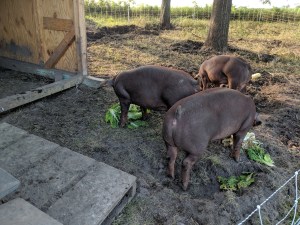
The girls enjoying surplus Cabbage….
My Duroc Hogs are picking up some slack, and seem to have developed quite a taste for zucchini. My good neighbor Jimmy continues his obviously well entrenched habit of baking exhausting amounts of zucchini bread, and distributing the tasty, spicy cakes to friends and neighbors. Alas Jimmy has his own garden and abundance challenges this time of year, so the “girls” or ‘Gilts” more correctly, have to do the heavy lifting on picking up the slack, with some help from our laying chickens. They’ll both concentrate the abundance for butcher in another couple of months. Unfortunately my lack of experience with the hogs, has led me to fail at the crucial unknown step in hog production. Booking the butcher the day they are born… so I may be stuck commoditizing 2 of my three carefully raised girls at Equity and have to embrace the challenge of butchering one myself.
As the month wanes the cool nights of September are provoking thoughts of winter, and my empty woodshed, so that’s the focus for September (a year or two later than desired but better late than never).
A check in on the larder:
Fuel:
Firewood- 2 cords of blow down cherry and ½ cord of elm.
Diesel- ~100 gallons of Ag diesel, waiting to refill till October when they start selling winter blend
Electricity- 15.5 kW solar array, still outproducing the farm as a whole. Estimates obtained for a second system to support the dairy and cheese plant.
Propane (heats the home when the wood runs out, as in today, and provides hot water for the dairy barn). House tank 800 gallons, barn tank 400 gallons.
Food (mostly tracking the stuff we aspire to be self sufficient on):
Veg and future veg-
Potatoes from last years remnants
Green beans- canned: 3 case of 12 quarts
Salsa- one case of pints
Potatoes-~ 100 lbs out of the ground and significantly more to harvest… now storage…hmm…
Dry Beans- About 1 pint of lovely native american heritage beans from Seed Savers that we’ve been growing for 3 years now-
About 100 row feet of the same beans still setting up in the garden
Abundant show pumpkins and more exciting, what looks like a nice harvest of Pennsylvania Long Necks for pies.
Lots of seed remnants and saved seed. An especially pleasing amount of Russian red kale seed from the overwintered plants.
Two quarts of dried hops and two (of three) surviving hop rhizomes seemingly well established.
Some well established wild Asparagus and some poorly established new aspargus beds
About a bushel of Hopi pink dried (drying actually) corn from a food corn experiment
Probably more of Texas Gourdseed coming
Animal protein and sources-
In the freezer-
About few cuts of last years hog
A few cuts of last years lamb
4 chicken roasters purchased from a work colleague.
6 chickens of three laying breeds, now 4 ish years old and still seasonally knocking out an impressive 1 egg/ bird/ day,
4 more laying hens of 2 new breeds now about 4 months old.
A growing flock of East Friesian/ Lacaunne composite dairy sheep, now in the 5th year
9 Ram lambs to market in about December
9 Replacement Ewe lambs who probably are all staying on the farm
The 4 berkshire gilts became 3 duroc gilts, they are estimating about 150 lbs now and I”m hoping they’ll go to market in NOvember.
Abundant deer and turkey on the back forty.
Fodder-
Several nice cuttings of grass and alfalfa hay have topped up the barns with the potential for one more cut on alfalfa and grass if it looks like some drying weather will happen
Two acres of nice looking grain corn to hand pick in October
Pastures are still mostly rich and growing and looking like they’ll enjoy some rain and warm weather.
Farm Income-
Monetary-
Perhaps 100 dollars on egg sales
About 250 on some cull sheep sales at Equity
Non-monetary
Haven’t bought a vegetable at the store since July 1st
We’ve been building for several years towards an aspiration of producing artisan cheese on our farmstead from a flock of dairy sheep. Having ruminant livestock was inspired by sitting on a tractor mowing grass every weekend for 4 hours, and the observation that when nothing else is growing in Wisconsin, grass and alfalfa are. Having small ruminants was inspired by my lack of personal exposure to managing cattle, and my professional experience to the dairy industry in a time of transition from a small dairy being 500 cows to a small dairy being 5000 cows. I’ve got another blog, or three, on consolidation in Ag, and at least with livestock it’s a mixed bag. But I didn’t work 30 years to own a farm and hire other people to do the farming, so no 5000 cow freestall aspiration here at Maggie’s Farm. Setting aside truly weird things like milking camels (poorly adapted to Wisconsin) and intimidating things (like water buffalo) we’re left with small ruminants. Then the choice was simple. I’ve liked a lot more sheep cheeses, than I have goat cheeses, that’s just the way it is (hint; it’s the FAT).
It’s one thing to know intellectually that dairying is a committed, all-in type of farming. Watching neighbors and friends in the industry over the years of my life showed me this was so. I watched these committed families with a mixture of admiration, envy, and a touch of confusion. So the inherent seasonal nature of milking sheep was a strong attraction to us. Some producers, and the UW dairy sheep program (before it’s demise), put a lot of effort into finding ways to “solve this problem”… but just like in Software, one man’s bug is another’s undocumented feature. Milking that actually stops once a year for a while is quite a feature.
This was our pilot year with the milk line and cheesemaking experimentation in the house. We lambed in 12 mature ewes, mostly in March, and left the lambs on for between 30 and 60 days. We only lambed twelve and started the milkline with just 10 sheep. We learned a lot this year, and so did our sheep. Among other things ‘what happens in the parlor, stays in the parlor’… a gentle play on the reality that stuff just get’s silly when you are trying to train a mixed group of dairy animals to a new milking parlor. There’s a mixture of bribery, coercion, persuasion, collusion… going in all directions. Sheep pushing us around, us pushing sheep around, the first few days were a circus…(now a few weeks after drying off, the girls still try to line up to go in the parlor when we walk in the barn…). Equally we learned that sheep have THREE personalities. Personality #1 is shown when you just sort of are walking around the barn feeding or doing chores… they range from extroverted people-sheep, to stand-offish and even skittish. Personality #2 is the ‘lambing personality’ many sheep late in pregnancy, and during the lambing process, become much more docile, even friendly. They seem to want a shepherd around and show it in numerous ways. Personality #3 is the milk parlor personality, which, as well, ranges from docile and charming to a new negative exteme… the nightmarish rabbit boiler. The most fun fact about these three personalities is THEY BEAR NO RATIONAL RELATIONSHIP TO EACH OTHER ! My most favorite sweet Babette, could not stand the process, even after weeks, she hated the parlor, she hated me, she may have even hated herself. She peed… twice a milking, only when there was a chance to hit me. She pooped, every milking, like she was saving it…my and Amanda’s hands and forearms are covered with bruises…from kicking, stepping upon, all sorts of shenanigans… a man of my age raised in sexist time struggles to find language to describe it. She was a tough and angry lady I had not met before…
Now a couple weeks after dry off she is my sweet Babette again… go figure.
Though my spreadsheets said this would be a lot of milk, I really struggled to believe we’d get enough milk from 10 sheep to meaningfully experiment with cheeses and processing. Boy was I wrong. Within three days of starting the line we were firmly in the throws of Milk-pocalypse. Within a few days our 2 gallon home pasteurizer was running 4 times a day, in between milk shifts, feeding, and other animal care, cropping and gardening duties. Quite an adventure and gave me better appreciation for why Amanda lost weight when she was interning for her cheese-maker licence.
We made yogurt, cheese, ice cream, butter… every dairy product we could imagine and thought we’d consume. We even resorted to freezing raw milk, a common practice with sheep dairying that I disdain on principal because of the energetic waste. Now about 4 weeks after the storm we still have dairy products in every form imaginable slowly expiring, or not, depending on their form. All of this at a time when I hadn’t even gotten a radish out of the garden due to an incredibly cool spring.
There were a lot of take-aways from this whole adventure but one of the biggest was that for anyone aspiring to ‘independent living’, ‘off the land’, animals fill a gaping whole in the dietary line-up, particularly in northern temperate climates where despite great tools like plastic hoop house greenhouses we really can’t produce veg efficiently, that humans can digest, for a solid 6 months of the year. But for 3 of those months grasses and other more adapted plant spp are knocking it out productively, and our ruminant ewes, and other ruminants, can turn this into copious amounts of human food, and with dairy, very well timed to the end of winter hole in the garden lineup. No wonder pioneer families, and small holders around the world today, prize livestock, especially dairy animals, so highly.
Well enough on milking, thanks for reading… next episode will likely be about my fabulous Duroc pasture raised feeder pigs, who are enjoying the now abundant garden produce, and the expiring fresh dairy products, and byproducts, while they spend their summer on pasture under the walnut trees, become delicious food for my family and a few select friends.
If you were hoping for more active blogging, well wait for winter when less is happening on the farm ! You can follow me on Instagram at jon_of_wisco (https://www.instagram.com/jon_of_wisco/?hl=en) , the barrier to snapping a photo, and thumbing in some commentary is low and overcome more frequently than the activation energy “To Blog”… which seems a lot more like writing, which I try do do cogently.
Weather and crops…
I must really be farming because I’m obsessed with the weather, and with signs of turning towards actual spring weather pattern this Sunday I’m upbeat, but it’s been a cool and frustrating spring for my first full time farming, with typical highs in the mid forties and lows in the thirties every night. Good weather for alfalfa and not bad for grass, and fortunately that’s more than ½ our cropped acreage. I’ve got chore lists for heavy rain, light rain, and no rain. The no rain list has been suffering badly. The weather has held back work opening my ‘new ground’, 5 acres A formerly christmas trees gone wild at 25 years ( I prefer my monoculture edible…). This plot needs love, attention, organic matter from the ewe barn, removal of woody organic matter from the former occupants, some pH and micronutrient attention from my ‘friends’ at FS, and some vigorous rock picking. 1 acre will get ½ a unit of leftover corn seed (not saved seed mind you MON) lto raise grain corn for the sheep, and 1 acre may get oats, to harvest as hay, or spur on my dream of buying an Allis All crop pulled combine (https://en.wikipedia.org/wiki/All-Crop_harvester). So much great technology from the first era of combustion powered ag ! . My alfalfa over wintered okay, considering we had a solid week of -20C lows, but it would like some grass and clover knifed in, which I’m equipped to do, and now that I’ve had some roundup over the top to check those nasty weeds.
The garden is a bit more forgiving of this tough weather as I can get in there with my awesome 2 wheel tractor, from BCS… sweet peas are sprouting, cabbage and lettuce transplants have been waiting patiently for the warm weather. Some overwintered Kale was promising a few salads but has obeyed it’s biennial habit and is instead going to be a saved seed crop. Potatoes are in, though my carefully selected certified seed potatoes arrived in the freezing weather and turned to disgusting black mush (ah, that’s what smelled so bad in the closet). Fortunately Amanda had been tending last years sprouting potatoes and they stepped into the gap. So far the only veg from the farm is foraged (ramps and feral asparagus) and canned but I’m hopeul that in two weeks we’ll be self fed.
Livestock-
The chickens are just banging along at 4 years old, feeding themselves foraging, managing to escape tragic predation by the local wildlife, and putting out almost an egg a day. We’ve been selling out to friends and family and are considering picking up another four from the rather desparate looking, formerly day old, now month old (and highly discounted) chicks at the farm and fleet.
The sheep are mostly well, the annual bottle lamb (orphan) has managed to consume the profit potential of about 5 lambs in veterinary bills, one of the challenges of our values based approach to livestock rearing, where finance is not the value measure. We aim to provide appropriate care while there is still a possible positive outcome, and only kill for harvest, or when pain cannot be managed. So far that’s been viable.
The milk line is threatening to get going next week for experimentation with pasturizing and recipes, but we’re still not licensed so none of that’s leaving the farm this year. My pig dreams have been frustrated by interstate veterinary transport rules, as well as practical matters and logistics, but I’m still hoping to finish a couple of pigs this year. We’ll see.
Stay tuned and thanks for your interest !
Plain living book recommendation of the month: The Foxfire book. A great education experiment, turned literary franchise that captures Appalachian life skills and the voice of the practitioners.
My land ethic journey is something of an experiment in ‘self sufficiency’ and sustainability. This part of the journey is a personal passion of mine, in part because in my work as a technology leader in Ag business for 25 years I’ve paid a lot of attention to ‘Ag issues’, sustainability, carbon footprint, livestock well-being and the like.
I’ve approached these issues with a number of conflicted feelings.
Genuine sympathy and pleasure, that a certain type of consumer actually cares how the food they eat impacts the world, the environment in which it’s produced, and the producer.
Frustration and anger that many of the same consumers are so easily manipulated by marketeers into buying organic, or worse ‘gmo free’ (I’m sure I’ll have a rant on this at some point, but if you want to avoid GMOs, buy organic, at least then you’re not avoiding safe plant incorporated protectents to take in more (largely equally safe) synthetic pesticides) foods, so far out of season they can’t begin to be local, from industrial food giants who often operate in all the ways they these same consumers seek to avoid.
And a scientific bent that makes me want to read primary literature when I encounter information or opinion that doesn’t seem to pass the sniff test.
All these feelings lead me to the simple instinct that people who care most deeply about these issues, as I do, would be well served to PRODUCE MORE OF THEIR OWN FOOD. Chicken’s are the gateway livestock, get some. Get a shovel and dig up your suburban lawn and try to grow a potato. That sort of thing. So by way of striving to change yourself before you change others I’m paying some attention to this on Maggie’s Farm.
Mid April in Southern Wisconsin is an useful time to start such an experiment because it’s at this point in the year when your larder is emptying out. So to the degree I want to understand how I do in this experiment it’s useful to have a starting point in some of the key consumables.
In the larder today 4-14:
Fuel:
Firewood- none (we’re out, plenty in the woods, great frustration of the executive job that paid for the farm was the inability to actually finish any single chore on the farm while so employed).
Diesel- 400 gallons of Ag diesel
Gas- we’ll not be tracking this with rigor, sorry purists, this is Leopold not Muir
Electricity- 15.5 kW solar array, one year old, grid connected from Drew’s Solar of Madison WI. Great folks: http://drewssolar.com/
Propane (heats the home when the wood runs out, as in today, and provides hot water for the dairy barn). House tank 800 gallons, barn tank 400 gallons.
Food (mostly tracking the stuff we aspire to be self sufficient on):
Veg and future veg-
Green beans- canned: 1 case of 12 quarts
Potatos (i’m right there with you Dan Quale)- ~ 10 lbs, now all seed potatoes
Dry Beans- About 1 quart of lovely native american heritage beans from Seed Savers that we’ve been growing for 3 years now-
Some rotting pumpkins and winter squash that will likely yield viable seed for the garden
About 100 dollars worth of new commercial garden seed, mostly from Gurney’s www.gurneys.com ,who are unpretenscious, have good germination (unlike seed savers for example) and have an annoying pricing mechanism around 50% discounts that carefully exploited makes their price almost reasonable.
The residues of 5 years of similar seed buys, carefully saved
Some hop rhizomes on the way from Northern Brewer
Some well established wild Asparagus and some poorly established new aspargus beds
Animal protein and sources-
In the freezer-
About ¼ of a delicious farm raised hog that Amanda bought from one of her cheesemaker mentors
The equivalent of 1.5 lambs, grown here on farm and butchered nearby, consisting of the cuts we don’t like the most (this is what happens when you eat the whole animal)
Sources-
6 chickens of three laying breeds, now 4 ish years old and still seasonally knocking out an impressive 1 egg/ bird/ day, almost entirely on food they scavange for themselves for 9 months out of the year. Chickens are gateway livestock, everyone who cares about food issues should have a few.
A vibrant flock of East Friesian/ Lacaunne composite dairy sheep, now in the 4th year
4 Berkshire Gilts promised by my former employer as a retirement gift, but not yet picked up,
If it were 1850 we’d be eating our seed… the goal would be to finish 12 months next spring in a less tenuous position, and feel good about how that’s been done.
So why the land ethic inspired site name? In gifting a copy of A Sand County Almanac (amazon link) to a friend from England I described Leopold as one of the three great voices in American Naturalist writing, alongside Thoreau, and Muir (with which some Scott’s may take issue).
If you’ve not read a Sand County Almanac, and you are reading this blog, stop and go take a run at it. It’s a poetic tribute to the turn of the year, much set in Wisconsin, and it’s a far better use of your reading time than following my self-indulgent adventure. If you haven’t read it lately, pick it up again and reread the closing chapter, the land ethic (I wouldn’t suggest you start here if you’ve not read the rest of the book, it’s thick, philosophical writing that shows that even Ph.D in Forestry is a Doctor of Philosophy, you’ve got to know the man, and his connection to the land in his other chapters to want to wade through this treatise).
As I sit here at the turn of 2019, anticipating the start of my land ethic experiment, this book which the copyright tells me was published 70 years ago this closing essay could have been written last week. The issues resonate, the core questions around how our values are centered, our relations to the natural world, where our obligations begin and end, to each other, to the land, to the earth. It’s a provoking treatise.
But Why Leopold’s ‘Land Ethic’ as the namesake for my experiment?
Thoreau is too easily dismissed as an urban romantic with some fine ideas, but a penchant for meals in town with his well heeled friends, rather than time hoeing his beans. His experiment, and his writing, provokes action and thought but even in his idealized recounting it’s evident that this is a temporary lifestyle change, a bit like spending a 250k on a tiny house and leaving there for part of a year before returning to your job in Seattle. A fine thing to do but not an experiment in long term sustainable living.
Muir also, has some connection to Wisconsin, his boyhood home. As a long term (seemingly successful) transplant to the upper midwest it’s tempting to imagine that there’s something about this geography that shapes people. There’s a beauty and appeal to the state that sits in the middle of three ecosystems with terrain both shaped, and spared, by glaciation. An attraction to a climate that is demanding enough to deserve attention and accomodation, but also forgiving enough to grow a good tomato. Thinking back, unencumbered by careful research, it’s easy to imagine from both Muir’s writing, and Leopold;s, that Wisconsin in the early 1900’s was a land showing the signs of 100 years of ill use. And for a certain type of outdoors inclined young person, there remained enough delight in the outdoors, to also provoke dismay at it’s mistreatment. This dismay seemed to lead Muir west, into the high country and the undisturbed wilderness and this childhood observation of an ecoystem so heavily trodden, provoked the passion for preservation of untrammelled wilderness that founded the Sierra club and inspired the preservation of the western national parks and the passionate but failed defence of the Hetch Hetchy valley. Muir’s passion is inspiring but to me it’s inspiring in the way of the ascetic. His passion is protection and preservation which I fully respect but I myself am more inspired to pursue how can we live in harmony with, rather than protect and live apart from, the natural world. And so Leopold’s more pragmatic, agrarian and sportsperson leanings are more attractive and inspiring for my own experiment. Can a family largely sustain themselves, sustainably, on 100 acres of paid-for land in the northern temperate latitudes?
This isn’t April 10th 2019, but looking out my window it might as well be…

 About 1.5 hours fills the UTV and the UTV fills about 8 saved 50 lb feed bags which get stacked in the corn crib. It all works pretty well until about January when the deer get really hungry and denude the field… I’m hoping that with not working I’ll be able to harvest the majority directly… we’ll see.

 n 2 dozen eggs from the store in 9 months, despite frequent omelets for breakfast and dinner




 Jon’s Land Ethic Journey